Language never stops moving. From the lyrical precision of Shakespeare’s verses to the crisp concision of modern slang, words have always evolved alongside us. They change as we do, adapt to how we think, and reflect our modern world. And if brevity is truly the soul of wit, I think our latest slang deserves a closer look. So how did we go from “Shall I compare thee to a summer’s day?” to “slay”?
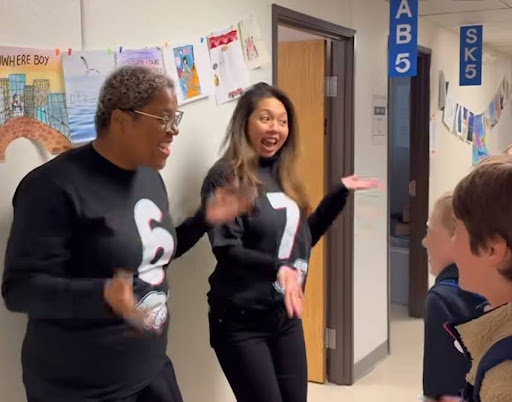
To dive into modern slang, let’s address the elephant in the room: “6-7.” What in the world does it mean? When I asked that question to a group of Lower Schoolers, they looked at me like I’d just asked if the sky is blue.
One said, with the sagacity of a philosopher, “It can mean anything you want or need it to mean. It’s a multi-purpose phrase. The possibilities are endless.”
Another chimed in, “It just sounds funny. Like, it just feels right to say.”
The slang “6-7” falls under a bigger category known as “brainrot,” which, as Merriam Webster defines it, is “material of low or addictive quality, typically in online media, that preoccupies someone to the point it is said to affect mental functioning.” What began merely as memes on social media has migrated into the daily language of Generation Alpha–the newest generation raised entirely in the glow of phone screens.
“I say ‘6-7’ like, six or seven times a day,” one Potomac Middle School student admitted, laughing. “It’s only funny because of the song and the viral TikTok video. But yeah, it’s kind of random.”
But for those who are a little less online, the phrase “6-7” can be puzzling.
Upper School history teacher Robert von Glahn first heard “6-7” from his own kids, and now he hears it echoing through Potomac’s hallways.
“You all just say these phrases randomly for no reason,” he said, bewildered.
Still, Mr. von Glahn approaches “brainrot” with curiosity. Reflecting on the slang of his own youth, he noted how its purpose has changed. “For us,” he explained, “[slang] was part of communication and to communicate meaning. Brain rot like ‘6-7’ doesn’t really have meaning or a definition.”
He remembers using the word “crisp”: “If something was crisp, that’s kind of a version of ‘cool.’ So that means something right? Whereas, if you say ‘6-7’ or you say “skibidi,” you’re not communicating.”
Somewhere along the internet’s evolution, the purpose of slang shifted from expression to absurdity.
That change is recent enough that even young people can feel the difference.
“Before, slang actually had meaning—like ‘rizz’ was short for charisma, and ‘huzz’ meant someone cute,” said one Upper School student, who preferred to remain anonymous. “Now we’re just saying ‘skibidi toilet’ and ‘6-7,’ and nobody knows what’s going on. It’s nonsense, and I find it hard to keep up with the latest trends.”
Dr. Paula Melissa explains, “Generation Alpha is more inclined to use slang that quickly evolves and adapts to interactive video trends. They engage in fast-paced, visual interactions, unlike the text-based trends more common among Gen Z.”
With brainrot phrases like “6-7” or “Italian brainrot,” the humor only lands if you’ve seen the original video on TikTok or wherever it was posted.
That distinction reveals something deeper. By its very origin, brainrot is bound to social media–the place where it was created. While most of our older slang, like “groovy,” “chill,” and “lit,” was born organically from lived experience, brainrot has been engineered to fit the algorithm.
“Every generation has their ‘thing’; someone rolled their eyes at the silly things we did and said in high school just as I roll my eyes at my students six or seven times a day. I think slang is evolving quicker due to social media,” observes Ms. Laura Petro, Upper School science teacher.
Our brains don’t process “6-7” the same way they once processed “cool.” The latter carries meaning and emotion. The former recalls a social media clip. Brainrot doesn’t root itself in definition or feeling, but in recognition of online content. So when we hear brainrot keywords in real life, the same neural circuits that light up during doomscrolling ignite again.
A Brain Science Journal study found that “as engagement on social platforms increases, so does the brain’s need for a dopamine hit. This creates a loop of perpetual engagement as the brain becomes addicted to the fleeting gratification that comes from new information, likes, or comments.”
That’s why brainrot feels addictive and irresistibly catchy. It reinforces the loop of instant gratification that scrolling social media produces–and with it, the same harms.
The National Institutes of Health suggests that this specific type of “brainrot,” born of social media and AI, leads to emotional desensitization, cognitive overload, and psychological distress. Its link to doomscrolling and social media addiction chip away at executive functioning skills that include memory, planning, and decision-making.
“Social media has also trained us to have shorter attention spans, crave the doomscrolling dopamine rush, constantly be connected, and believe too much of what we see without thinking critically about what is pushed into our feeds,” said Ms. Petro.
According to a 2025 UK study, the average teen’s attention span on social media is now 6.5 seconds per video, which is scary because…that’s shorter than the 9-second attention span of a goldfish.
So…are we cooked?
No! At least, not if we use brainrot on our own terms. The way language evolves, for better or worse, depends on how we wield it. Words don’t have meaning unless we assign meaning to them. The context and creativity behind them matter far more than the syllables themselves. If we give our words a purpose by choosing when to use them instead of simply chanting them like a reflex, we’ll stay in control of our attention spans and not the other way around.
We’re not doomed after all! If we can survive Shakespeare’s sonnets and “skibidi toilet,” we can probably handle “6-7.” Just…maybe not six or seven times a day.