There’s something unexpectedly fascinating about a pile of dirt—especially if it used to be your lunch.
“It’s crazy to think that all of this was food,” said Cecelia Russell ‘27, a co-leader of Potomac’s Students for Environmental Action club (SEA), gesturing excitedly toward a huge bin piled high with dirt. Looking at the mound of rich soil beside her, the result of over a year of commitment and hard work, it’s easy to see what she means.
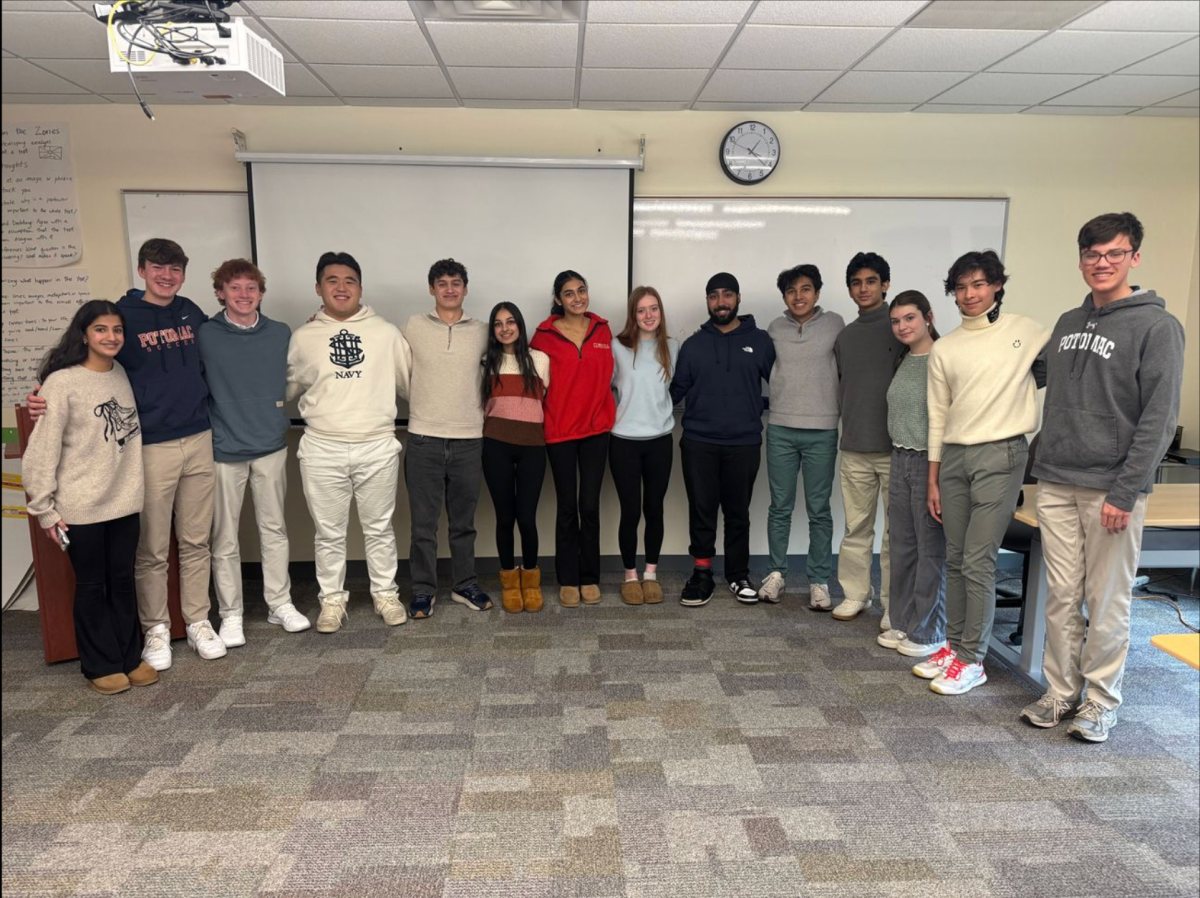
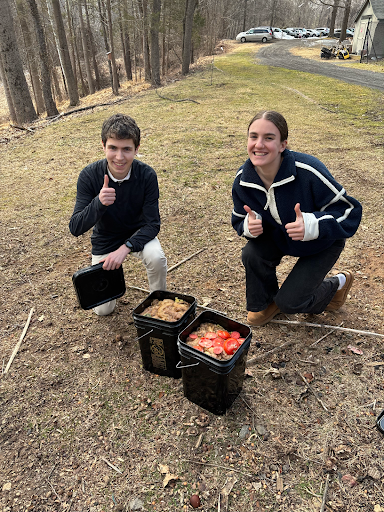
On a typical Wednesday afternoon, while many students are heading home, a small group heads in the opposite direction, toward a bin outside the science hallway. Gathered around the wooden receptacle, these students dedicate their conference block to sorting through food scraps and turning what was once lunch into something entirely different: compost.
After gathering multiple buckets of food scraps from the cafeteria—from melon rinds to avocado pits—the group walks to the compost bin and pours the contents in. The regular volunteers showed me how to turn the compost using a shovel, folding fresh scraps into older layers of decomposed material so that microbes can break everything down into nutrient-rich earth.
“It is incredibly rewarding to know that you’re helping the environment, even if it is such a small contribution,” co-leader Isabella Song ‘27 shared when asked about the most memorable parts of composting with SEA. Indeed, composting seems like a small contribution, but it quickly proves its impact by reducing food waste at Potomac and making use of scraps that would otherwise end up in landfills. Since last spring, Potomac SEA club members have been consistently composting our lunch scraps—an effort that pays off in an estimated 10 gallons of food waste becoming compost every week. According to Isabella, that adds up to nearly 100 gallons since the initiative began.
So what happens when the compost is finally ready?
“The soil will probably be used to grow vegetables in our gardens,” Song explained. But the benefits of composting go beyond its fertilizing properties. She noted that 8% of all greenhouse gas emissions come from food decomposition in landfills and that the water used to grow uneaten food is staggering. “We compost not just for the nutrient-rich soil,” she said. “We [also] compost to reduce water wastage.”
As I walked away from the compost bin that Wednesday, it was hard not to think differently about my habits.
As Russell reflected, “Small habits can make a big difference. Sure, we might not be single-handedly saving the Earth with our weekly composting, but what we are doing is instilling a habit in ourselves. Habits compound; once they become familiar, they can make a big difference.”
Students for Environmental Action club is building a system of sustainability at Potomac: one Wednesday at a time.
But composting is only one part of SEA’s growing efforts, as the club is taking another step towards greener habits on campus through a project aimed at reviving student-led recycling at Potomac. Currently, the school has two single-stream 8-yard recycling containers for its primary recycling needs. These containers are mostly used for cardboard and paper, with smaller amounts of plastic bottles and metal cans, and they are picked up twice a week on Tuesdays and Thursdays. Additional modes of recycling are also in place. There is a metal recycling container located near the transportation shop, which is picked up four to six times per year. Meanwhile, electronic waste is collected and recycled twice a year. Cooking oil from the kitchen, as well as waste oil generated from transportation, are also recycled.
While recycling has long been a part of our school’s sustainability efforts, past attempts at expanding it within classrooms have faced a series of logistical challenges. In the past, US advisories and IS homerooms would collect materials across campus, emptying classroom and hallway bins into larger containers for disposal. At the time, much of this material was sold overseas in bulk under far less stringent contamination standards abroad. This changed in 2018 with China’s “Operation National Sword,” which tightened restrictions on contaminated recycling.
According to Potomac’s Director of Sustainability, Mr. Sean Conroy, “The primary sources of contamination were plastic bags, plastic film/wrapping, general trash, and non-recyclable items entering the recycling stream.” Furthermore, when the 2020 pandemic disrupted the student-led system, the janitorial staff took over recycling duties.
Yet despite facing a number of setbacks, the recycling among students is being adapted and returning with greater care and focus. In 2024, the IS launched a model that has successfully reduced contamination, specifically by introducing designated bins with “paper-only” labels. Building upon this success, the SEA Club launched a similar program this spring, placing labeled bins throughout the Upper School. The goal is to prompt students and faculty to pause before tossing in just any piece of garbage, reminding them what belongs in recycling and what doesn’t.
SEA co-leader Maddy Sadler ‘26 said, “In many ways, I believe that recycling at the Upper School mirrors our own community’s process of learning and improving.”
The program officially began in April with the SEA team continuing to gather and educate volunteers. These volunteers will collect the paper from the labeled recycling bins once a week and take it to the dumpsters. By maintaining a regulated, consistent process, the risk of technical errors, such as cross-contamination, is significantly reduced. Moreover, introducing the new system in the East Building allows the school to see how the new bins play into the students’ and faculty’s everyday routines.
“We want to develop a system that’s realistic and convenient for our community, and hopefully expand upon it in the future,” Sadler notes. As for now, redeeming recycling in the Upper School in a streamlined, reliable way remains the top priority.