After studying abroad in Fiji last summer, Hedges ‘27 returned with two things: a fascination for bull sharks and a clear objective—to support them in any way they can.
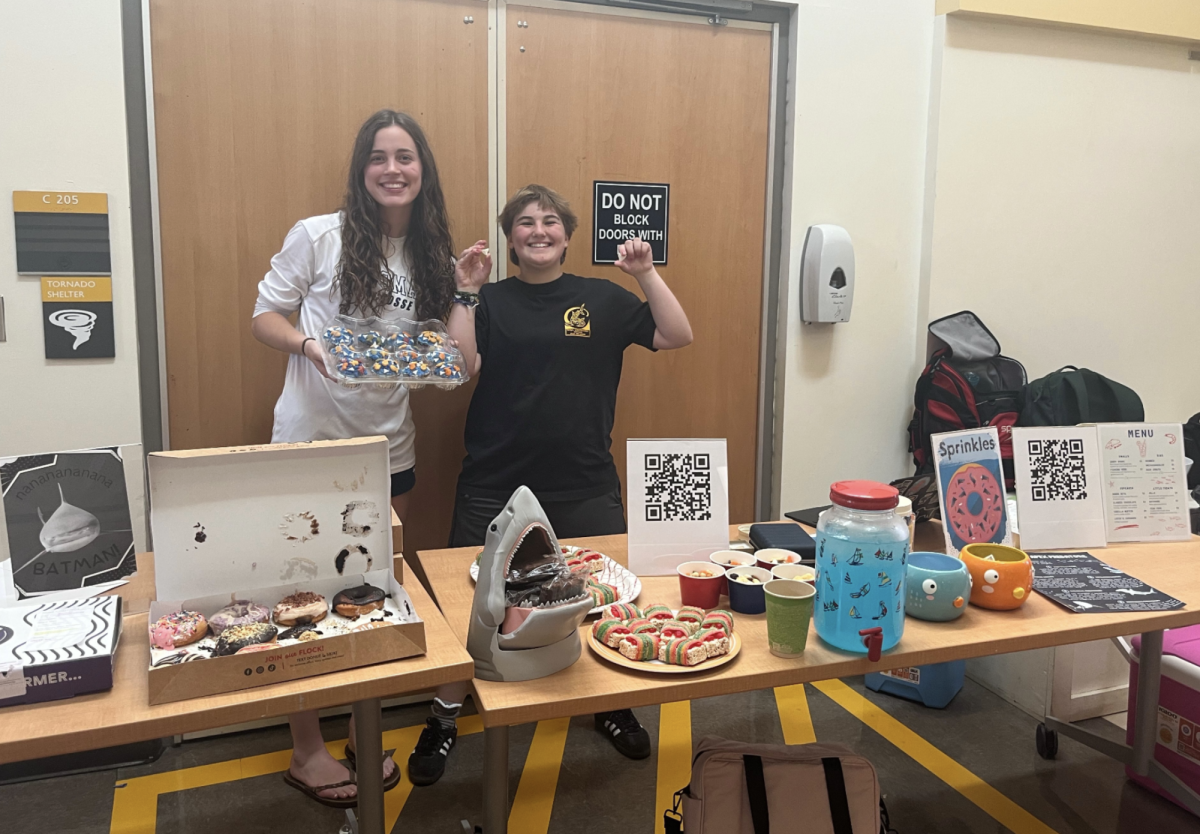
Last Friday, that objective took shape in the East Building hallway in the form of colorful candy sushi, brownies, and Duck Donuts. Despite competing with the free pizza and Captain Cookie offered during Springfest festivities, Hedges’ bake sale still raised more than $415 for the Fiji Shark Lab and the Shark Reef Marine Reserve.
The fundraiser was rooted in something greater than a school bake sale. While in Fiji, Hedges became deeply involved in the country’s marine ecosystems and the role they play culturally, economically and environmentally.
“Something that people probably don’t know about Fiji’s marine ecosystem is just how important it is to the Fijian culture and their way of life,” Hedges explained. “So much of their internal economy comes from fishing and ocean-related trade, plus a lot of their external economic impact comes from ecotourism.”
Hedges became particularly interested in the Shark Reef Marine Reserve, home to the world’s largest known aggregation of bull sharks. But unlike most bull sharks, which are highly migratory, this particular population remains unusually stationary, something researchers still do not fully understand.
“The reason for this is still unknown,” Hedges admitted, “but I hope to contribute the tag I’m working on as a continuation of my SERC 10 project to their research so we can get to the bottom of this fascinating group of bull sharks.”
Bake sales are impactful not necessarily for the money they raise, but for the issues they bring to light. Shark conservation can feel geographically and politically distant, something that’s usually typical of documentaries or climate conferences. Hedges made that cause accessible to us by bringing it into the East Building hallway.
“It’s not easy to compete with Captain Cookie and free pizza, but we managed to surpass my $350 goal,” Hedges said. While the fundraiser exceeded its original goal, it points toward a larger issue that Hedges hopes more people will think about long after the donuts are gone. “Beyond just raising money, success for this event to me would mean bringing awareness to the Potomac community about the crucial role that sharks play in protecting our oceans,” Hedges explained. “I’d love to keep the ball rolling after this and keep educating the Upper School on what they can do to protect our oceans.”
Organizing such a well-curated fundraiser is difficult, particularly during junior spring. “The hardest part of organizing this was definitely just the baking,” Hedges said. “Even trying to find just an hour throughout the week to bake something was nearly impossible.” Because of that, Hedges said the support from friends throughout the afternoon mattered even more, especially Aoife Cullinan ‘27, whom they credited with helping run the bake sale.
For students interested in supporting the cause themselves, the Fiji Shark Lab offers an “Adopt a Shark” program, allowing donors to symbolically adopt individual sharks while contributing directly to marine conservation and research efforts. After spending several minutes scrolling through the website, your correspondent read about bull sharks adorably named “Batman,” “Naughtylus,” and “Sprinkles,” each accompanied by profiles detailing their respective behaviors and movement patterns.
“A lot of people don’t realize how important marine ecosystems are to the preservation of the entire Earth,” Hedges said. “Now, more than ever, they are so crucial if we want to reverse or mitigate any of the impacts from climate change.”
As Hedges’ fundraiser demonstrated, sometimes environmental advocacy begins less with sweeping policy changes or distant climate conferences, but more so with a table of brownies and a heart open for change.
Click here to donate to the Fiji Shark Lab!