At Potomac, certain school events, like Prom, come with a seemingly generous policy: no homework. At face value, this sounds great—a weekend that actually feels like a weekend. However, it doesn’t always unfold that way. Students often experience a buildup of workloads right before the weekend, only to be met with a test the following class next week, ultimately limiting how much of a break the weekend actually provides.
Do no-homework weekends serve their intended purpose, or do they just rearrange the same amount of work? Tristan Mankovsky ‘27 and Brandon Mayrhofer ‘27 offer their respective (differing) views of the practice.
YES: No-homework weekends support student well-being – Tristan Mankovsky ‘27
The idea behind no-homework weekends is simple: students need time to step back. Often with very little downtime, Potomac students juggle demanding classes alongside sports, clubs, and other extracurricular commitments. Having the occasional weekend without homework gives us a rare chance to reset: to catch up on much-needed sleep, spend time with friends and family, or just take a break from constantly thinking about school.
Academically, research suggests that a pause helps prevent students from burning out and actually improves productivity. As one study from the University of Cape Town found, “Without regular time to recover, fatigue accumulates over time, which can lead to chronic physical and psychological consequences such as burnout,” while periods of recovery are linked to “higher levels of performance during the subsequent…period.” When every weekend is filled with studying and assignments after a long week of tests and projects, it’s easy for work to suddenly begin blurring together, causing students to lose focus and fall into a spiral of endless scrolling. Instead of constantly working at half-capacity, students can fully recharge and return to school ready to engage.
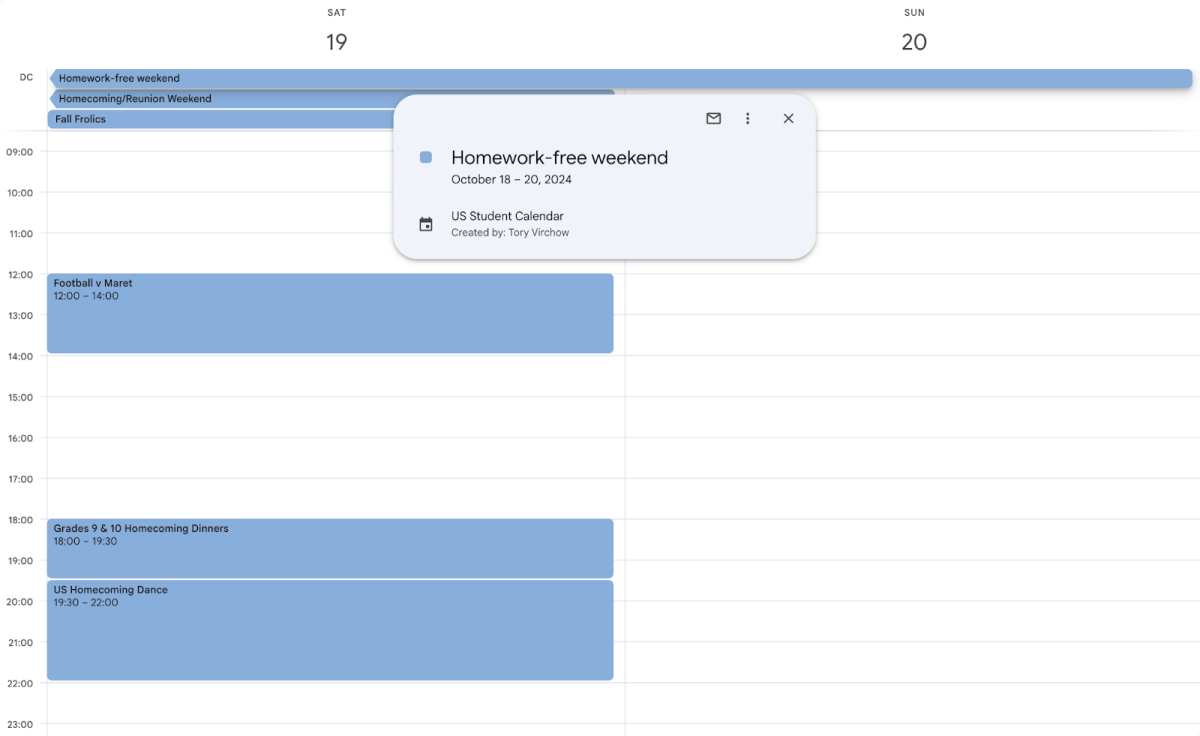
These no-homework weekends are especially important when they coincide with major events like Homecoming or Prom, which leave students with little time to get work done. And, realistically, nobody wants to study before or after a full day of partying. Without the policy, students would be forced to choose between fully enjoying these times and staying on top of their academics, two priorities that shouldn’t have to be mutually exclusive. More importantly, these are school-sponsored events that Potomac actively encourages students to attend, and as such, it would be contradictory to promote participation in these experiences while also assigning work that makes it harder for students to fully engage.
Of course, there is the problem of work building up in the days beforehand or tests being scheduled right afterward. However, while that can happen for some classes, it doesn’t negate the overall benefit that no-homework weekends provide: a temporary break. Not every class will shift its workload, so there’s still a clear net reduction in work. And even if some work is pushed earlier, that’s still better than forcing students to juggle assignments during relatively busier weekends of the year.
Ultimately, no-homework weekends are necessary in order to create a better balance in student life. The idea is not to eliminate work that must get done, but to prevent that work from conflicting with school-run, widely-attended events in unreasonable ways. Students are still responsible for their work, but they’re given occasional space to manage it in ways that allow them to both succeed academically and actually enjoy the parts of high school that take place outside the classroom.
NO: No-homework weekends redistribute more work and stress rather than eliminate them – Brandon Mayrhofer ‘27
The intentions behind no-homework weekends are understandable: giving students a break from the stress of school. I think to any logical person, this sounds like a great idea. However, not all good intentions translate into good practices. In reality, these weekends often do more to redistribute the work and stress rather than eliminate it. To be clear, I do not see this as the fault of teachers, but rather a fundamental flaw with the design of no-homework weekends themselves.
The most obvious problem that I have witnessed personally, and have heard from other students, is the compression of work. Teachers do not, and cannot, just make work disappear. They end up having to move it around. Assignments pile up in the days leading up to the no-homework weekends, and then again in the days after. Students are returning to a fresh wave of assignments and quickly approaching deadlines that feel like they come from nowhere. What was supposed to be a break quickly turns into a gauntlet of assignments, tests, and quizzes. Students spend Wednesday and Thursday beforehand rushing to meet due dates, only to return on Monday to tests and more assignments. The “free” weekend ends up being sandwiched between unnecessary stressful stretches of time. Many students have voiced frustration with these seemingly unnecessarily busy times of the school year. One student anonymously commented that in the classes that do have a heavier workload over no-homework weekends, they feel like they are faced with the lose-lose choice of either doing homework and studying over the weekend, or having to do more than a usual night’s homework in the days leading up to and coming out of a no-homework weekend. I think that most Potomac students fall into the former, with this student agreeing that most students still end up doing some sort of homework or studying over the weekend so that they do not feel behind or come back to an abnormally large workload.
The weekend itself–the time that no-homework weekends are intended to free up–is often when students normally have the most time and energy to complete that work. While weekends are often filled with other activities, like Homecoming and Prom, I still find them not as busy as any given day during a regular school week. Without the pressure and time constraints of a regular school day, students can work at their own pace, take breaks as they see fit, and spread out their work as comfortably as they want to. A no-homework weekend takes away that flexibility. Instead of doing an assignment on a Saturday afternoon or a Sunday morning when you have nothing else going on, you’re forced to do it on Thursday night alongside all of your other commitments, like sports, appointments, and other homework. That’s not a break; it’s just a worse version of the same workload.
Some teachers have also expressed that they sometimes struggle with the side effects of no-homework weekends too. They find it challenging when they teach the same class with blocks that fall on different days, and no-homework weekends can make it practically impossible for them to keep everyone together without having to change the workload. This leaves teachers with an impossible decision: either having to cut some of the material that students need to learn or squeeze it into an already jam-packed schedule. This can result in some blocks having to cover more material and do more work in a shorter time frame than others. The very policy that was created to try to help reduce stress for students is not only ineffective for students, but it also adds stress and work for teachers because they now have to try to keep all their classes on track.
No-homework weekends, in theory, are a great idea, but they don’t actually help students in practice. No one is arguing that students don’t need stress reduction; they do, but no-homework weekends are not the solution. These weekends end up leaving you with a bigger mess to clean up than you would have had in the first place. To me, it is a policy that feels like a gift, but one that functions more like a trade-off. Until the underlying issue is addressed, declaring weekends “off” is not a solution. I am not sure what the correct answer is, and I am not trying to pretend that fixing student stress is simple, but I think that the first step is being honest about what is working and what is not; in my opinion, no-homework weekends, however well-intentioned they are, are not working.
Conclusion:
In the big picture, everyone wants the same thing: a student body that is less stressed, more rested, and better able to enjoy their high school experience. The disagreement is not about whether students deserve a break (they do), but rather about whether no-homework weekends are the right way to provide one. The pressure and stress of school are real, and whether no-homework weekends are the solution or not, the broader question of how we can incorporate a better balance in students’ lives is one worth talking about, and not just around a couple of weekends a year, but all year long.