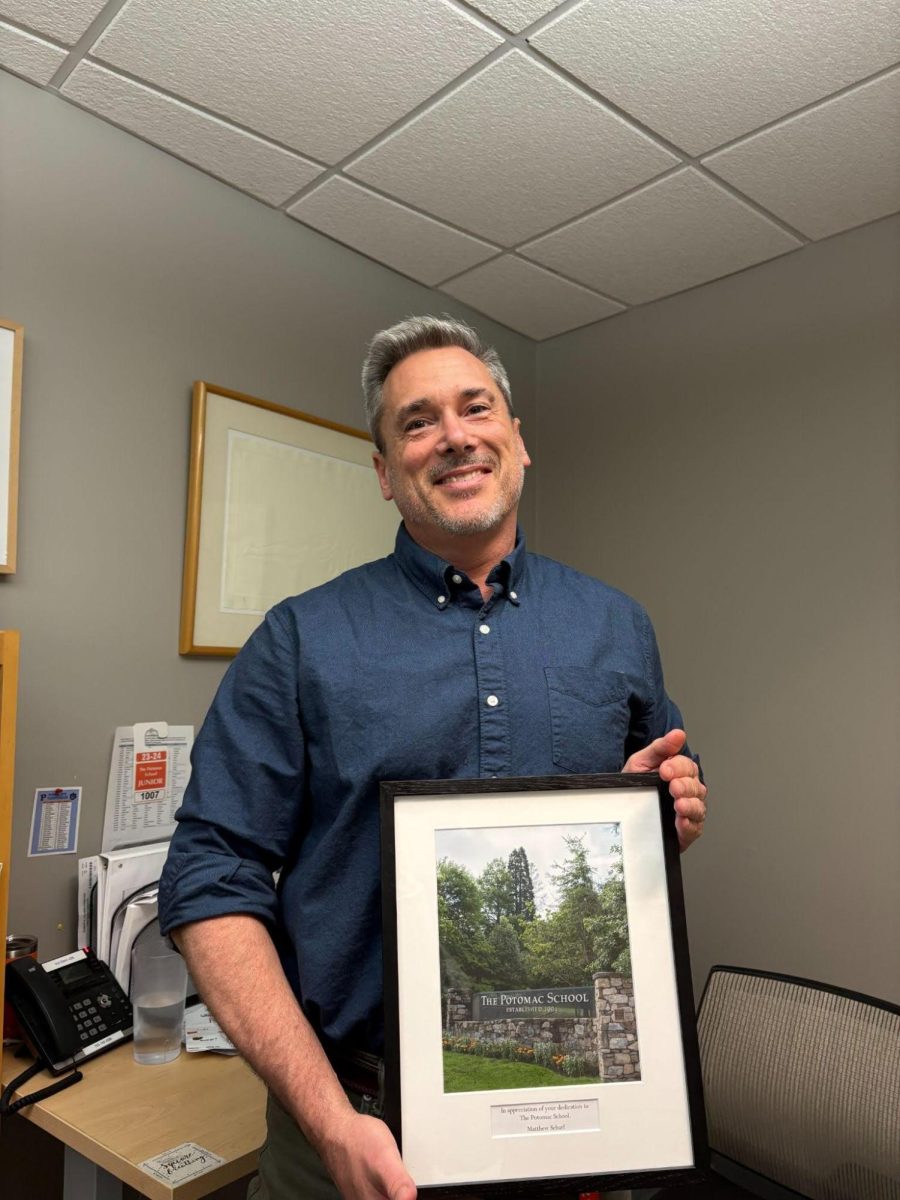
William and Tristan’s interview with Mr. Jordan took place on October 22, 2025
William: Now that you’ve been at Potomac for a while, what has surprised you the most about the community, or the school, in general?
Mr. Jordan: I can’t say that it was a surprise, but the positive nature of the whole community has surpassed my hopes. I got a glimpse of how positive and connected the whole community was when I interviewed last year, and I would say that has held true.
Tristan: What’s been your favorite part of being at Potomac so far? What moments this year have made you feel the most connected to the Potomac community?
Mr. Jordan: I’d say my favorite part has been seeing the positive relationships that students have with faculty and the administration here. I think feeling and seeing the positive energy that students bring to campus each day has been uplifting for me, as well. And honestly, I’d say the moments that have made me feel the most connected were all of the events of this past Homecoming weekend. And I really enjoyed the K-12 Pep Rally. It was really neat seeing the younger kids get excited about that. And in addition, the Homecoming events were a lot of fun, particularly seeing everybody in grades 9-12 interacting together, and not being totally separated by their grade level.
William: Are there any specific initiatives you’ve liked working on? What are a few of the biggest changes you want to pursue in the future?
Mr. Jordan: Seeing that it’s only about two months into my first year, it’s so important for me to just live the Potomac life, going through things for the first time, so I haven’t really put forth anything new, just coming from myself. There are a few things that have been tweaked a little bit this year, but they had already been in the works since last spring. I would say that an area of emphasis is to continue to support and foster student leadership development, both formally and informally. I think the best kind of school cultures are ones where the students are really out in front. Obviously, students can’t make every decision in a school, but I want to take advantage of student interest and talent and really have them drive a lot of student life activities. So I would say that is one area that’s important for me to continue to support. And I’d say school-wide, and as an Upper School, we’re refocusing our conversation around the place of AI, asking ourselves, “What is the appropriate use of and place of AI in the evolving academic landscape?” So that is a big K-12 area of focus, and I think that that’s going to be an ongoing conversation. I don’t think it’s something that we will ever solve. It’s going to be a moving target. But that’s something I know that the faculty is very focused on.
Tristan: What have been some challenges in your transition to Potomac?
Mr. Jordan: I’d say, fortunately, overall, that the transition has been very smooth. I think a challenge has just been meeting everybody in the community and trying to get to know the names and faces of students, parents, and people in other divisions. I just think that’s a natural challenge when you’re new in a big community. But fortunately, everyone’s been very welcoming and supportive of me, and that’s made the transition feel very smooth.
William: When you first spoke with the Current late last year, you stated your priority was to listen and learn. Has anything you’ve heard from students and faculty here shaped your leadership approach?
Mr. Jordan: So as I mentioned earlier, I’m still very much focused on just living the life of Potomac for a year; listening and learning, and working with others to identify areas in the Upper School, whether academic or otherwise, where we can continue to evolve things. I like to use the term “to become even better.” Potomac is a fantastic school, but I think it’s fun to be able to think creatively about evolving, whether it’s academic opportunities, student life opportunities, or co-curricular opportunities. I think that great schools are always thinking about ways that they can improve. I’ve been pleased to see that a lot of adults embrace that growth mindset. And so I think over the course of the next few months, I’ll be working with the faculty to identify some areas that people would be excited to think “What’s next for Potomac?” So, I don’t have anything concrete to say that we were going to focus on, you know, “this initiative next,” or “that initiative next.” But I think over the next few months, we’ll begin to identify some areas that we want to be a main focus, because, believe it or not, you want to start talking about potential shifts or tweaks way in advance during the [preceding] school year because it’s hard to make changes mid-year. And so the cycle for change or innovation usually [involves] talking about it throughout a school year and then identifying some things to implement the following year. I would say that my approach and my commitment are still the same. There will be things even in the month of May that I’ll have never experienced before, so it’s important that I keep focused on being a learner.
Tristan: You also talked about the importance of supporting students beyond academics. How is Potomac addressing student well-being this year?
Mr. Jordan: Great question. I think the way Potomac is structured, with adults in so many positions of support, whether it be advisors, grade-level deans, learning specialists, or counselors, allows us to have a close eye on students and gives us a sense of whether someone seems to be off from their normal self or not, in terms of their day-to-day. I’ve also been impressed as I’ve learned that there’s programming for all grade levels that will take place at various times throughout the year–not everything is done right at the start. Programming touches upon various aspects of student wellness in a very comprehensive way. And also, we have a lot of programming for parents, which is important, as well, so that parents can understand how we come at mental health from a school standpoint. We try to connect so that the school and parent partnership is pretty tight. But the other thing that students might not know is that there’s a group of adults that form a student support team, and they get together every week to make sure that we’re going through and thinking about every student, and surfacing names of the folks who might need a little more help or support at times. So again, we’re trying to stay very current with making sure that we can support student needs and be proactive. I’ve been a part of those meetings and have been very impressed with the level of thought and care that goes into certain situations where sometimes, kids need a little more help and support at various times throughout the year, for various reasons.
William: Is there anything else you’d like to share with Upper School students as you continue your journey at Potomac?
Mr. Jordan: It’s truly been a great first two months. I love coming to work every day, and I enjoy feeding off of the positive energy and the positive relationships that students seem to have with each other and with their teachers. I’m also impressed that students have such a wide range of interests and talents here at Potomac. And so it’s fun to, on one hand, be able to talk to one student about sports, and another student debate, another student about art, another student about an independent research project they’re doing, and so on. I think that this just adds to the collective diversity in our community, so that’s been very impressive, and I’ve really appreciated the warm room. And as I said, I love looking forward to coming to work every day.
Editor’s note: This interview has been edited for length and clarity.





![Why Do [They] Do This, Perhaps You Ask:](https://potomaccurrent.org/wp-content/uploads/2025/11/59298293-A1C3-451F-BCF6-FE44AB9A6E80_1_102_o-1200x900.jpeg)