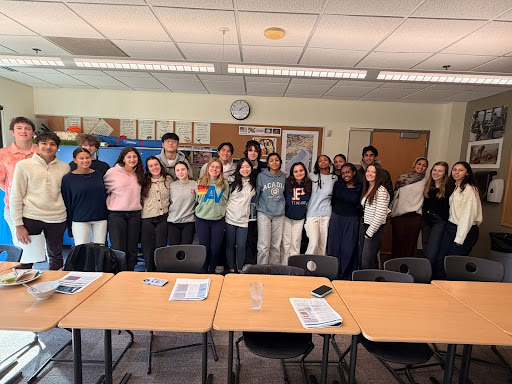

Although forewarned of the slump to come, I never expected it to hit this hard. As we start new school years, we often have time to adjust to the new responsibilities we take on; however, jumping from freshman to sophomore year has been an adjustment like no other.
Sophomore year is not just different material, but a quicker pace, later nights, and more opportunities for advanced learning. In addition to the honors courses introduced in eighth and ninth grade, sophomore year begins concentration programs such as SERC (Science and Engineering Research Center) and GPAC (Global Perspectives and Citizenship).
As I interviewed students from both SERC and GPAC, they acknowledged a significant increase in their workload. Marya Khan ‘28 claimed her nightly workload, being in Honors Algebra 2 and SERC, has increased the duration of her homework each night by 150%. Furthermore, taking such rigorous courses has Khan “always moving” and needing to be attentive for longer periods of time. In order to get this work done, Khan pointed out how she “[appreciated] to-do lists, on paper, way more” than those online. For Khan, being able to look at her physical planner and cross out what she has completed, keeps her focused and driven. Any structured place where you can look to for all your assignments and responsibilities will be your lifeline throughout high school and beyond.
Now, organizing the tasks is one step in the right direction, but sometimes we miss the mark on our coursework or need help along the way. Anika Agrawal ‘28 emphasized how important it is to make time during breaks, conferences, and free periods to “connect with [teachers] and understand their expectations for the class.” Agrawal is part of the GPAC program, and for her, spending one-on-one time with her teachers allows her to get to know their standards for the class material and get advice on how to go about certain questions. Although admitting that her concentration program challenges her, Agrawal states that she and her fellow GPAC members have “gotten close really quickly,” which has been a great relief for her. In general, building strong relationships with whomever you might work with can be fundamental in lessening the stress associated with the sophomore slump.
Along with the academic challenges, playing high-demanding sports can also throw on a new load of stress to the sophomore struggle. Lara Sabin ‘28 expressed the toll her sport–tennis–has taken on her body and time management. Due to her recurrent travels for tennis, Sabin finds herself needing to finish homework and eat meals in the car. Nevertheless, Sabin still finds time to relax and cool off. On her lighter days, in terms of work, she spends time walking and talking with friends, which balances out the work/social ratio that, as high-schoolers, we are learning to manage. An additional way that Sabin finds time to decompress is by making sure that all her work is complete by ten o’clock–no matter what–so that she has thirty minutes of downtime to unwind before she heads to bed.
Although, it may seem like a little change to create to-do lists everyday, meet with teachers to alleviate confusion, and allot breaks for hanging out or recovery, they are practices that will help in the long run of sophomore year and into the rest of your life. Life will never get easier, but we learn to manage the ups and downs better; take in the tall orders and see what becomes of your struggle.